A baby bassinet when the baby spits up? Key details that new families need to know.

Many new families encounter a common problem: their baby spits up right after feeding. If they are using a baby bassinet, is it safe? Should they pick the baby up immediately? Can the baby continue to rest in the bassinet?
This question seems simple, but it actually involves many details such as posture, structural design, angle adjustment, and the timing of use.
Many families initially believe that buying a high-quality cradle is all they need to ensure safety. However, what truly affects safety is often how it’s used, rather than the product itself. Below, we’ll systematically explain this issue from multiple perspectives, including physiological reasons, safety risks, correct practices, product selection, and common usage misconceptions.
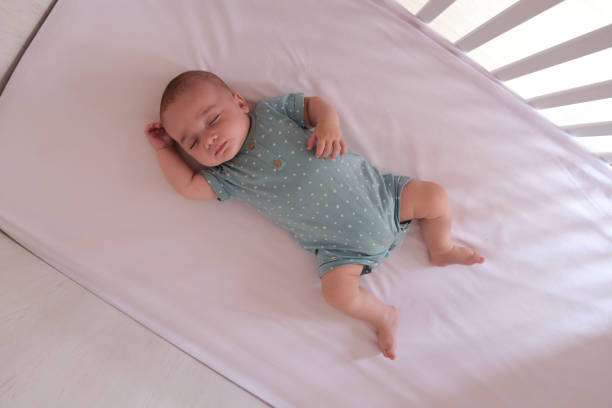
Why do babies spit up milk easily?
Understanding the reasons is essential to determining whether a baby bassinet is suitable for use during the spitting-up stage.
Spitting up is very common in newborns, and the main reasons include:
Small stomach capacity, easily filled
When the stomach is in a horizontal position, milk can easily flow back.
Immature development of the cardiac sphincter
Swallowing more air
Too rapid changes in body position after breastfeeding
Feeding too fast or too much
This means that spitting up is a physiological phenomenon and does not equate to danger, but improper handling can create risks.
Is it safe to use a cradle when a baby spits up?
The answer is not absolutely “safe” or “unsafe,” but depends on three key conditions:
Condition 1: Is the cradle angle reasonable?
If the baby bassinet is positioned completely flat, placing the baby in it immediately after feeding can indeed increase the risk of milk reflux.
Ideally:
The head is slightly higher than the body.
It has a slight tilt angle (approximately 5–15 degrees).
It can keep the airway open.
Many adjustable-angle baby bassinet models are more user-friendly in this regard.
Condition 2: Has the baby been burped?
This point has been severely underestimated.
If you haven’t burped the child, put them directly into the cradle:
Gas rises from the stomach
Milk is easier to push out
The probability of spitting up increases significantly.
Most childcare professionals recommend holding the baby upright for 10–20 minutes after feeding before putting them in the bassinet.
Condition 3: Is the shaking too fast?
Some automatic rocking cradles have a fast rhythm, which is not good for babies who have just finished drinking milk.
Avoid the following after breastfeeding:
Shaking violently
High-frequency vibration
fast-paced swing
A gentle, slow pace is more suitable.
What is the most dangerous situation when a baby spits up?
What we really need to be wary of is not “spitting up,” but rather
Spitting up + lying on your back + unattended
Risks arise from:
Milk residue in mouth and nose
Airway obstruction
Unable to turn over in time
The swallowing reflex is not yet mature.
If your baby spits up in the baby bassinet at the same time:
Full supine
No head tilt
No one was watching.
The risk will increase.
Safer placement recommendations
When a baby is prone to spitting up, the following positions can be optimized in the baby bassinet:
Slight head tilt
Help the milk flow out naturally, rather than flowing back.
Slightly raise your upper body
Reduce stomach reflux pressure.
Do not wrap too tightly
Binding too tightly will increase abdominal pressure.
Use a breathable mattress
Reduce the risk of traffic congestion.
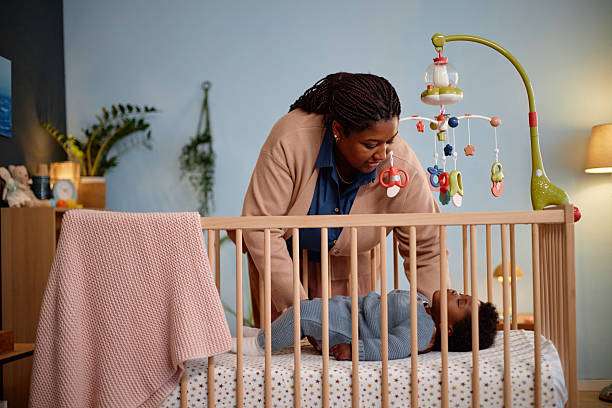
Which types of cradles are more suitable for the spitting-up stage?
From a practical standpoint, baby bassinet products that are more suitable for the spitting-up stage typically have the following features:
Adjustable angle
breathable fence
Stable base
Slow rocking mode
Easy-to-clean lining
Anti-slip fixing structure
Some families later switch baby bassinets because they find that their early choices didn’t take into account the cleaning issues of spitting up and spilling.
A detail often overlooked by many families: surface material
It is easy for spit-up to seep through.
An ideal baby bassinet configuration includes:
Removable and washable fabric cover
Anti-penetration inner layer
quick-drying fabrics
Material that does not retain odor
A friend initially chose the thick cotton mattress protector, but it took a very long time to wash and dry. Later, she switched to the Baby Bassinet with a removable waterproof layer, which significantly improved the cleaning efficiency.
How long after breastfeeding can I put my baby in a bassinet?
Commonly recommended time ranges:
|
Condition |
Recommended time |
|---|---|
|
Regular breastfeeding |
10–15 minutes |
|
Easy to spit up |
20 minutes |
|
It has anti-fluid properties |
20–30 minutes |
During this period, you can:
vertical hug
Burping
Walk quietly
Afterwards, putting in a baby bassinet will significantly reduce the likelihood of spitting up.
These common misconceptions should be avoided.
Continue rocking immediately after spitting up.
This will exacerbate the backflow.
Feed again immediately after spitting up.
This may lead to a cycle of vomiting.
Lie flat and put down quickly
Sudden changes in pressure can easily cause backflow.
Used soft cushion
It is prone to causing dents.
When is it not recommended to use a baby bassinet?
Baby bassinets should be discontinued in the following situations:
Continuous projectile vomiting
Spitting up accompanied by choking
abnormal complexion
rapid breathing
Crying due to obvious discomfort
At this point, you should pick them up and observe them first.
safely use a baby bassinet to help with nighttime spitting up?
Recommended for use at night with baby bassinet
Placed within the bedside’s visible range
Use micro-tilt mode
Do not use high-speed shaking
Keep the bed surface dry
Preparing to replace the pad
Delay putting down after nighttime feeding
This approach leverages the convenience of a baby bassinet while also mitigating risks.
A fact that many families only realized later
Many families only realize after using it for a period of time that
The baby bassinet is not a device that can be “put in and be safe,” but rather an auxiliary tool that “requires proper use.”
One parent shared their experience: when their baby was spitting up frequently in the early stages, they adjusted the timing and angle of putting the baby bassinet in, and the number of spitting up decreased significantly, and the baby’s sleep became more stable.
FAQ
Q1: Can my baby continue to sleep in the baby bassinet after spitting up?
Yes, but you should first clear your mouth and nose, make sure your breathing is smooth, and adjust to a slightly tilted-up posture.
Q2: Will an automatically rocking cradle worsen spitting up?
The pace might be too fast. We recommend using a slower pace or temporarily turning it off after feeding.
Q3: Do I need a special anti-spit-up pad?
It helps, especially during the stage when milk is prone to spilling, as it reduces the cleaning burden.
Q4: Is it safer to sleep on your side in a baby bassinet?
Slightly turning your head to one side is acceptable, but it is not recommended to sleep completely on your side without supervision.
Q5: Does spitting up mean the cradle is not suitable?
Usually not; the more common cause is feeding rhythm and posture issues.
Ending:
Spitting up is a very common part of a baby’s growth, and using a baby bassinet correctly can greatly reduce the burden of nighttime care while ensuring safety. The key lies in four points: angle, timing, rhythm, and supervision.
If you are choosing or upgrading your baby bassinet, prioritize styles with adjustable angles, easy-to-clean materials, and a stable structure, as these will make daily care much easier.


