Is your baby too dependent on being held to sleep? Maybe it’s not your fault; a baby bassinet might be a gentle transitional option.
Many parents have experienced nights like this: The baby wakes up as soon as they are put down but can sleep soundly as long as they are held in their arms. Their arms ache and their backs hurt, but they can’t bear to put the baby back in baby bassinet.
Gradually, “sleeping in someone’s arms” became a habit but also a source of pressure.
Many parents repeatedly ask themselves:
Have I been hugging you too much?
Will I be unable to be without your embrace from now on?
What should I do if this continues?
Actually, being held to sleep isn’t wrong; it’s often just a baby’s most instinctive way of seeking security. During this stage, a baby bassinet might be a less aggressive yet very effective transitional option.
Don’t rush to dismiss the idea of holding a baby to sleep: it’s a baby’s natural need.
In the first few months of life, a baby’s familiar world consists of only three things:
heartbeat, body temperature, and gentle rocking.
When you hold it in your arms, all three are there.
So babies fall asleep more easily not because they are “spoiled,” but because:
An embrace provides continuous physical contact
There is a stable sense of rhythm (breathing and heartbeat).
Low environmental change, low stimulation
From a baby’s perspective, being held to sleep is an extremely reasonable and safe option.
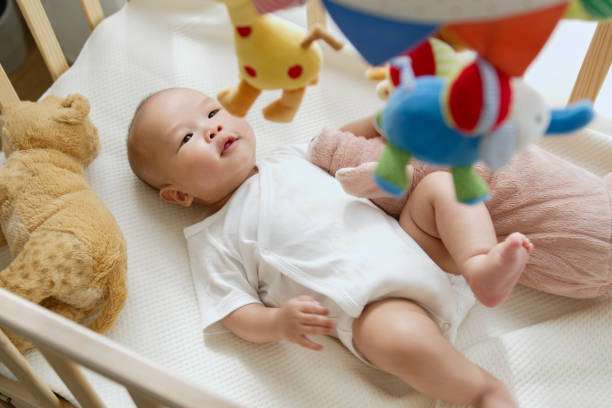
Why does holding your child to sleep make parents increasingly tired?
The problem isn’t with the baby but with the fact that this method is difficult to maintain in the long term.
Many parents will gradually realize:
Arms and neck are often tense
I’m afraid to sleep deeply, worried about unsafe sleeping positions.
I experience decreased energy and become more emotionally sensitive during the day.
I went through that period myself. At first, I held my baby to sleep, thinking that “as long as he was at ease, that was fine. ” But after a few weeks, my body couldn’t take it anymore, and I became prone to emotional breakdowns.
At this point, what we need is not to “forcefully give up sleeping with your partner,” but to find a middle ground.
Why is a baby bassinet considered a gentle transition?
Many parents associate “changing sleep patterns” with crying, resistance, and failure. But the advantage of a baby bassinet is that it doesn’t force babies to “sleep independently” all at once.
It’s more like it’s mimicking a few key aspects of an embrace:
It feels enveloping, rather than completely open.
The space in the baby bassinet is relatively concentrated so that the baby is not suddenly exposed to an overly large environment.
There is a slight swaying rhythm.
This rhythm is very similar to the feeling of being carried and walked around by parents.
It’s not necessary to completely cut off companionship.
Parents can gently pat and talk to the baby so the baby won’t feel “abandoned.”
This is why a baby bassinet is often more readily accepted by babies who are cuddled to sleep.
You can gradually transition from holding your baby to letting them sleep to letting them sleep in your arms.
This is an important point:
Don’t expect to succeed on the first try.
Step 1: Place the baby in the baby bassinet while the baby is in a semi-awake state.
Don’t wait until you’re completely asleep before putting it down, and don’t put it down when you’re extremely awake.
During this stage, babies will notice changes in their environment but will still retain a sense of security.
Step 2: Retain familiar methods of comforting.
pat
Familiar voice
A fixed bedtime routine
After the baby was put into the cradle, I would gently rock him a few times using the same rhythm I used when holding him to sleep so that he would know that “this is still the same period of sleep.”
Step 3: Allow for brief repetitions
Some nights, the baby will still cry for a hug, but that doesn’t mean all the previous efforts have been in vain.
The establishment of sleep is inherently a process of repeated progression.
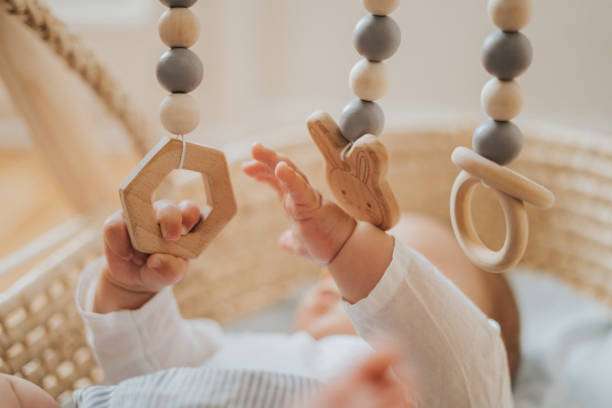
Why do some babies initially resist baby bassinets?
If you’ve tried it but the results weren’t ideal, it’s likely not that your method was wrong, but rather that these details need adjustment:
Excessive or rapid shaking
Babies are more likely to be startled awake than soothed.
The timing of letting go was wrong
Being too awake or too asleep can increase feelings of resistance.
The cradle position is not suitable enough.
If the neck and back are not properly supported, it will make the baby feel uneasy.
During that time, I thought the baby could only be held to sleep.
Until one day, I was so tired that I put him in the cradle, sat next to him, and gently rocked him, without leaving him immediately.
He cried a few times but quickly calmed down. It was then that I realized:
The baby didn’t need me but was learning new ways of being.
After that day, I stopped rushing to “train” and instead used the cradle as a companion rather than a replacement for me.
When is it inappropriate to force the use of a baby bassinet?
It’s important to note that not all situations are suitable for immediate introduction:
The baby is obviously uncomfortable or unwell.
During peak growth periods, the need for security is particularly high.
The parents themselves were very tense.
In these situations, stability is more important than change.
FAQ
Q1: Will using a baby bassinet increase dependency?
Proper use will not cause problems. The key is to gradually reduce shaking and intervention, rather than extending it indefinitely.
Q2: Does a baby crying mean he/she is not suitable?
Brief protests are normal; if the crying continues, you need to check the posture, rhythm, and timing.
Q3: Do I need to use it every day?
No need. It can be used only at night or during specific times to maintain flexibility.
Q4: Will I be able to smoothly transition to a crib later?
Most babies will find it easier to accept other sleep environments once they have established a sense of security.
Summarize:
Being dependent on being held to sleep doesn’t mean you’ve done anything wrong.
It simply means that you and your baby have chosen the gentlest and most direct method at that moment.
A baby bassinet is not to replace holding but to give parents space to gradually let go and to give the baby a gradual adaptation process.
If you’re feeling physically and emotionally drained by being held to sleep, try using a baby bassinet as a transitional companion rather than a training tool.
Go slower and be gentler, and you’ll find that your baby’s adaptability is far stronger than we imagine.
Related Posts

Is your baby too dependent on being held to sleep? Maybe it’s not your fault; a baby bassinet might be a gentle transitional option.
-
Posted by
 Jones Emma


