The Baby Bassinet still suitable for babies who have started crawling ? A complete analysis of stage changes and safety considerations.

Many parents encounter a crucial stage: their baby transitions from simply lying down to starting to roll over and attempt crawling. At this point, many people ask – can we continue using the baby bassinet ? Is it unsafe? Should we immediately change their sleeping space?
The answer to this question isn’t a simple “yes or no,” but rather depends on the baby’s developmental stage, weight, activity level, and the design of the cradle you’re using . Below, we’ll systematically explain this from several aspects, including developmental signals, safety standards, usage scenarios, and alternatives.

What does it mean when a baby starts crawling?
When a baby begins to exhibit the following behaviors, they have entered a period of rapid improvement in their motor skills:
Able to roll over independently
Can support body with arms
Try kneeling and rocking back and forth.
Start moving forward or backward
Will grab the edge and try to stand
During this stage, a baby’s strength, coordination, and exploratory drive will significantly increase. Spaces that were originally suitable for quiet sleep, such as the baby bassinet used in the early stages , need to be reassessed to see if they are still appropriate for their current abilities.
What was the original design intention behind baby bassinet ?
Most baby bassinet products are designed for newborns to early-month-old babies, and their core features are:
The space is relatively compact, enhancing the feeling of being enveloped.
Low height, easy to look after
The rocking structure helps to soothe.
Suitable for children who are not yet able to roll over or have only rolled over slightly.
In other words, the cradle is more of a “soothing sleep tool” than a “sleep container for high-activity phases”.
Is the cradle still safe after the baby starts crawling?
Can it continue to be used?
A cradle can continue to be used for a short period of time if the following conditions are met simultaneously :
The baby has just started crawling and is trying to move around.
Still unable to stand up with support
The cradle fence is high enough
The bottom structure is stable and does not wobble.
The product clearly states that it supports older babies or heavier babies.
Some high-end baby bassinet models feature raised guardrails, anti-tipping structures, and locking rocking functions, making them safe to use even during the initial climbing phase.
Situations where it is recommended to stop using
If these behaviors occur, you should consider stopping the current baby bassinet .
The baby can stand up by grasping the edge.
It will forcefully flip the top edge.
Height close to the top edge of the fence
When rocked, the baby can actively change their center of gravity.
There is a risk of it flipping out or getting stuck.
baby bassinet at this stage significantly increases the risk.
A real risk that many people overlook
Many parents are concerned about “whether it will fall out,” but they overlook another issue— the risk of tipping over and crushing their children .
When the baby’s activity increases:
Turning around repeatedly in a confined space
It will squeeze your body to the corner
Will put their head on the soft edge
It will get stuck in the support rod or joint.
A friend mentioned that their baby was already able to roll over and turn around while still using a baby bassinet , and would wake up from the side several times at night. However, after changing to a different bed, the baby’s sleep became more stable.
Insufficient space can negatively impact sleep quality.
Differences in the applicability of different types of baby bassinet
Not all baby bassinet are the same, and their safety boundaries differ.
Traditional rocking type
Shortest usage cycle
Suitable for newborns
It is generally not recommended to continue using it during the crawling phase.
Fixed bracket
Higher stability
It has a locking function
Extends usage time
Convertible
Can be converted to a fixed bed mode
The fence is higher
Longer life cycle
If your baby bassinet supports “stop shaking + raised railing + reinforced base”, it will be safer than the regular model.

When should you transition from baby bassinet ?
You can refer to these “bed-changing signals”:
The baby can roll over continuously
Baby tries to stand with support
Baby’s weight is close to the product’s upper limit.
The baby’s sleeping space has become noticeably narrower
Baby frequently wakes up when he touches the edge of the door.
If you meet two or more of these criteria, you can prepare to transition from a baby bassinet to a crib or playpen.
How can the transition phase be arranged to ensure the smoothest possible transition?
Many babies are sensitive to changes in their sleep environment; a gradual approach can be used:
Take a nap in the new bed during the day
Continue using the familiar baby bassinet at night (short term).
Use the same sleeping bag and comforter.
Maintain a consistent sleep routine
Reduce environmental stimuli changes
For families, it’s best to keep the baby bassinet as a comforting space during the day and switch to a larger bed at night for a smoother transition.
How can the cradle continue to function?
Even if it’s no longer used as a primary sleep aid, the baby bassinet still has its uses:
Daytime comfort zone
Temporary rest area in the living room
Short-term care space
Travel backup sleep spot
Sleep aids
It remains a practical piece of equipment as long as it is not used as a long-term, unattended sleeping container.
FAQ (Frequently Asked Questions)
Q1: My baby can crawl but can’t stand yet. Can I continue using Baby Bassinet ?
You can continue to use it for a short period of time, but make sure the baby bassinet fence is high enough and stop the rocking mode and switch to the fixed mode for safety.
Q2: Do the baby bassinet and crib need to be replaced immediately?
It doesn’t have to be immediately, but once the baby starts to stand up, you should transition them from a baby bassinet to a higher-fence sleeping space as soon as possible.
a baby bassinet with a locking function safer?
Yes. Lockable baby bassinet structures are safer during active periods because they reduce the risk of tipping over due to changes in the center of gravity.
Q4: My baby is big but can’t crawl yet. Can I continue using the cradle?
baby bassinet if the weight exceeds the standard , even if the baby’s mobility is not yet strong.
Q5: My baby is sleeping well in the cradle, do I need to change it?
If a baby is already highly mobile, even the most comfortable cradle may pose a safety hazard, and safety boundaries should be prioritized.
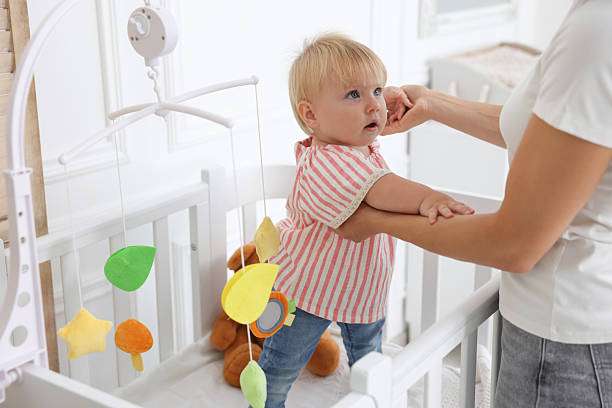
Conclusion:
Cradles are excellent early childhood care tools, but their value lies in “stage adaptation,” not in “the longer you use them, the more cost-effective they become.” When babies enter the crawling and exploration stage, their safety needs change, and their sleeping space should be upgraded accordingly.
Rather than waiting for risks to emerge before making changes, it’s better to plan a transitional solution in advance.
If you’re evaluating whether to continue using Baby Bassinet , now is a good time to check the fence height, structural stability, and load-bearing capacity. Choosing a high-specification product that is safety certified and supports locking mechanisms or convertible designs will give you peace of mind during the transition.


