Does your baby prefer a light or dark baby bassinet? Many parents make the wrong choice at first.
When preparing sleep products for their babies, many parents spend a lot of time researching functions and safety but often overlook a seemingly “just aesthetic” issue—color.
Many people struggle, especially when choosing a baby bassinet.
Are lighter colors gentler?
Won’t dark colors scare my baby?
Does my baby really care about colors?
In fact, color is not an “unimportant” detail; it has a subtle relationship with a baby’s sense of security, level of relaxation, and even how quickly they fall asleep.
Today, let’s talk from the parents’ perspective: Is it easier for babies to accept light-colored or dark-colored baby bassinets?
Do babies really “understand” colors?
This is the first question many parents have.
The newborn stage: It’s not that they “can’t see it,” but rather that it’s “easy to see.”
In the first few months after a baby’s birth, their visual system is still developing.
- More sensitive to high contrast
- Limited ability to distinguish soft and complex colors
- It relies more on “light and dark variations” than on the color itself.
In other words, what the baby perceives is not “is this a light or dark color,” but rather:
Does this space make me feel safe or nervous?

Light-colored baby bassinet: Why do many parents choose this color first?
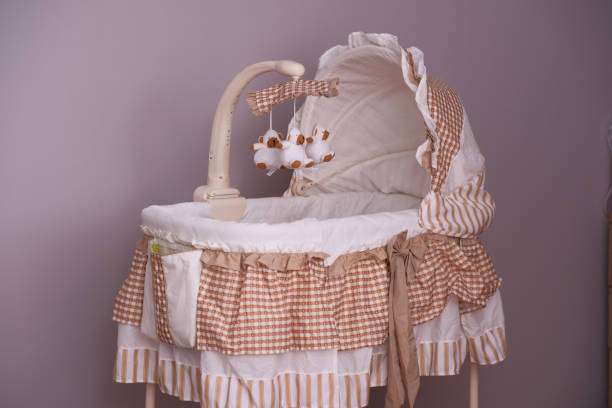
Light colors are the most common choice on the market, such as off-white, light gray, light wood color, and light pink.
The immediate feeling brought by light colors
- The space is brighter
- It looks clean and light.
- Parents are more relaxed
Parents’ emotions can directly affect their babies.
When I first chose a cradle, I almost instinctively picked a light color. Every night when I got up to soothe my baby, seeing the soft color made me less anxious, which I later realized was very important.
Potential effects on the baby
- The light reflection is softer, and it is less likely to create strong shadows.
- The visual stimulation is relatively mild, making it suitable for a sleep environment.
- It makes it easier for babies to stay relaxed when used during the day.
For families who frequently use their homes during the day and place them in the bedroom or living room, light colors do indeed create a greater sense of security.
Are dark-colored baby bassinet colors really unsuitable for babies?
Many parents’ first reaction upon hearing “dark color” is
- Will it be too oppressive?
- Will the baby be scared?
But that’s not entirely true.
Dark colors do not necessarily equate to “stimulation.”
Dark colors (such as dark gray, dark blue, and natural wood tones) do not harm babies in themselves; the key lies in the usage scenario and matching.
Darker colors may actually be more suitable in the following situations:
- High frequency of use at night
- Babies are particularly sensitive to light
- The room was generally bright.
Dark colors can reduce light reflection and make the environment “quieter.”
Some babies actually relax more easily in a “darker” environment.
Babies, especially those who are light sleepers at night, are very sensitive to brightness.
If the cradle itself is a darker color, it can actually reduce visual disturbance.
I have a friend whose baby sleeps well during the day but is always “woken up” by a brightly colored cradle at night. After switching to a darker color, the number of times the baby wakes up at night has decreased significantly.
What babies care about more is not the shade of color but the “overall feeling.”
This is a point that many parents easily overlook.
A baby’s perception of the environment is a combination of several factors:
Light + Color
- Light color + strong light → may be too bright
- Dark colors + dim light → Makes it easier to fall asleep
Material + Color
- Light-colored, soft fabric → highly soothing
- Dark color but gentle material → equally comfortable
Parents’ reaction
Whether parents are relaxed or frequently adjust the baby’s position will be “sensed” by the baby.
So instead of agonizing over “which color is more scientific,” you should ask yourself: if
If this cradle were in my home, would it make the whole space quieter?
Color selection suggestions for different usage scenarios
Primarily used during the day
- Living room, well-lit room
- Baby naps and short rests during the day
More suitable for light colors, visually light, and not stimulating.
Primarily for nighttime use
- Frequent use of the bedroom and nighttime feeding
- Hoping to reduce nighttime awakenings
You could consider darker but not oppressive colors such as dark gray, dark beige, or natural wood tones.
Emotionally sensitive baby
- Easily startled
- Highly responsive to environmental changes
Choose low-contrast, low-stimulation colors; don’t pursue brightness or depth. The key is “stability.”
At first, I also thought that “lighter colors are definitely more suitable for babies,” but later I found that whether a baby is calm or not has far less to do with the color itself than with how it is used.
When lighting is well controlled, the baby is in a suitable position, and the soothing rhythm is stable, the baby is not particularly picky about colors. On the contrary, it is when parents worry about colors and frequently adjust the environment that they can disrupt the baby’s sense of security.
FAQ
Q1: Will lighter colors make it easier for the baby to wake up?
In bright light, this is indeed possible. Therefore, it’s fine to use during the day, but you should be careful to block out light at night.
Q2: Will dark-colored baby bassinets affect a baby’s eyesight?
Normally not. A baby’s vision development is mainly related to light and distance, not the color of the cradle.
Q3: Will the color of the baby bassinet affect a baby’s personality?
There is no direct evidence. A stable and safe sleep environment is far more important than color.
Q4: Do I need to frequently change colors to stimulate my baby?
Not recommended. Babies need familiarity more than change during sleep.

Summarize:
When we choose baby bassinet, At that time, color was not for “looking good,” but for:
- Make the environment quieter
- Make parents more relaxed
- Make it easier for your baby to fall asleep
Whether it’s a light or dark color, as long as it doesn’t create stimulation or increase anxiety, it’s a suitable choice.
Choose colors that make you feel at ease, and your baby will often feel more at ease as well.
Related Posts

Does your baby prefer a light or dark baby bassinet? Many parents make the wrong choice at first.
-
Posted by
 Jones Emma


