Baby Bassinet: Electric Cradles vs. Manual Cradles—Which One Can Be a Helpful Assistant for New Parents?

A baby bassinet’sBaby Bassinet rocking function, whether manual or electric, is based on simulating the movements of a fetus in the womb, making it an effective way to soothe newborns.
I know all too well that in the quiet of the night, the rhythmic hum of the electric cradle is a lifesaver, as it concerns not only the baby’s sleep but also the physical and mental health of the parents.
stage butFrom a childcare science perspective, we need to distinguish between “soothing to sleep” and “sleep training.” Electric rockers offer unparalleled advantages in the “soothing to sleep” stage, but require strategic use in the “sleep training” stage. In modern childcare, we cannot ignore the immense value of effective tools in alleviating parenting fatigue.
High-efficiency parenting brought about by high technology
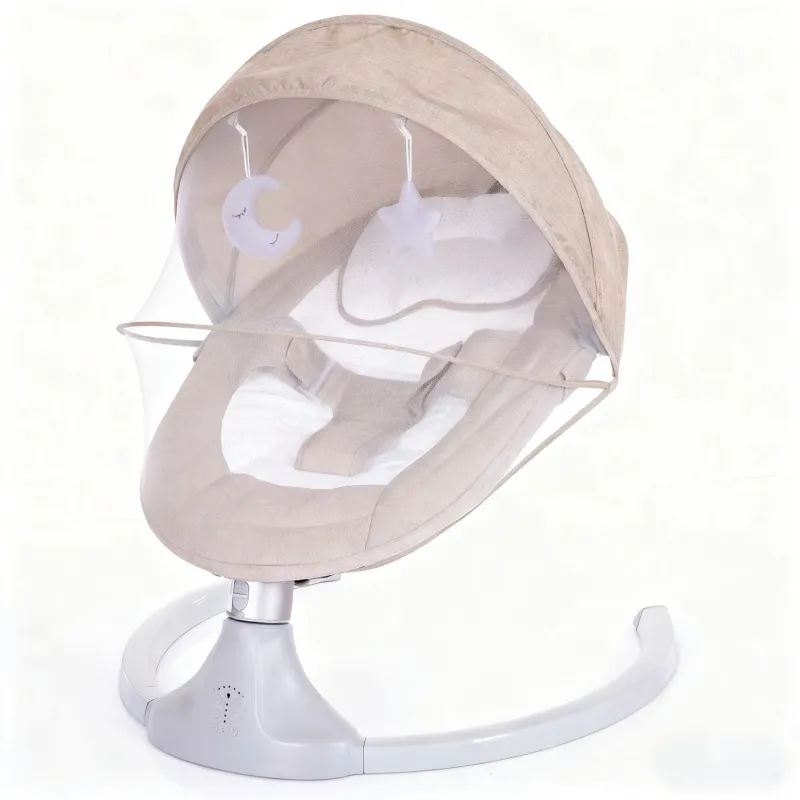
A babyBaby bassinet (such as an automatic cradle or smart rocking chair) provides constant, repetitive, and predictable external stimulation, making it a powerful ally for tired parents.
Core advantages: High efficiency, stability, and saving parents’ energy.
High efficiency and consistency: The Baby Bassinet motorized rocker provides a constant frequency and amplitude that is difficult for parents to achieve manually. When an infant cries, it quickly activates the baby’s soothing system, achieving rapid calming. Research also supports that regular rocking helps shorten the time required to enter slow-wave sleep.
Parenting resource management: This is the most underrated value of the Baby Bassinet electric rocker. It frees parents from the constant manual rocking and allows them to focus on self-recovery, caring for the older child, or completing other essential tasks.
If an electric cradle allows me to sleep an extra hour at night, then that extra hour of rest is invaluable for giving me more patience for sleep training during the day.
Potential Risk: Dependence Due to Tool Misuse and the Formation of Sleep Associations: This is the risk of electric rocking. If infants always fall asleep while the machine is in motion, they will perceive it as a necessity for falling asleep.
Nighttime Wake-Up Challenge: It’s normal for babies to wake up at night. Once the rocking sensation in their environment disappears, they may not be able to fall back asleep on their own.
fault butWhen my baby was three months old, I mistakenly used an electric cradle, turning it off only after she had completely fallen asleep, which caused her to wake up frequently at night. This wasn’t the machine’s fault, but rather a mistake in our strategy.
The irreplaceable nature of emotional connection
A baby bassinet’s manual rocking motion lies in its emotional connection and controllability.
Emotional connection: The act of rocking manually, accompanied by the comforting sound of a parent’s heartbeat and body temperature, helps to build a deep emotional connection and a sense of security.
Advantages of easy transition: The inconsistency of manual rocking allows parents to consciously and gradually slow down and stop rocking as the baby is about to fall asleep.
Later, when dealing with my second child, I would manually rock her until her eyes started to droop, then immediately stop and hold her still until she fell completely asleep, instead of rocking her until she was sound asleep. This controlled “transition” is an irreplaceable flexibility of manual rocking in cultivating independent sleep.
Disadvantages: The main disadvantages of manually rocking a baby bassinet are parental fatigue and low consistency, which is especially difficult to maintain at night.
Strategic use of electric swing
From a sleep training perspective, over-reliance on any form of baby bassinet rocking is detrimental. However, we should view electric rockers as an effective parenting strategy tool, not an obstacle to sleep training.
Key strategy: Leverage the advantages of electric oscillation while mitigating its risks.
| Sleep stage | Swing strategy | Objective: To leverage the value of tools |
| Short-term sleep training (0-3 months) | Low-speed electric rocking motion (for sedation only) | Use its efficiency to quickly soothe the baby. Key: Place the baby in a static crib when they are drowsy rather than fully asleep. |
| Early stage of sleep training (4-6 months) | Limited manual rocking | Take advantage of its flexibility during the transition. Parents should stop rocking the baby before they fall asleep, allowing the baby to clearly recognize that they are falling asleep in a static environment. |
| Sleep training phase (6 months and above) | Completely stop swinging | Remove all external aids and establish self-soothing abilities. An electric cradle can serve as an emergency comfort device for unexpected situations at night. |
Summarize:
The Baby Bassinet electric rocker is an effective soothing tool that utilizes a baby’s primal soothing reflex, providing exhausted parents with essential resources and respite.
My experience tells me that parenting tools are a double-edged sword, but using them correctly can make you a more relaxed and patient parent. The core of successful sleep training is helping babies break their “sleep associations” with any external stimuli.
Parents should view electric rockers as a strategic aid to relieve parenting stress**, with the ultimate goal of helping babies develop self-soothing abilities in a still, safe, and predictable environment.


