Baby Bassinet and Baby’s Sleep Schedule: A Comprehensive Guide to Healthy Sleep

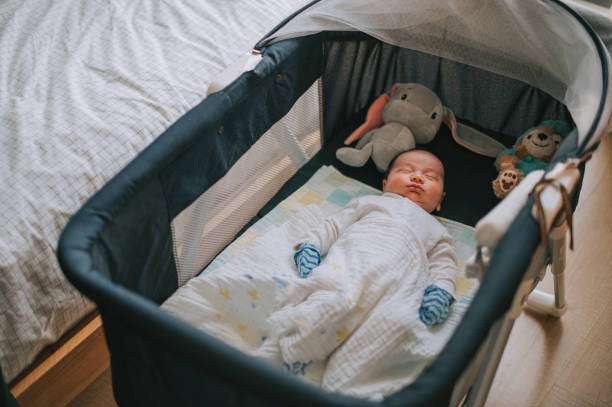
Establishing a regular sleep schedule for babies is a major challenge for new parents. Frequent nighttime awakenings and irregular daytime naps often leave parents exhausted. To help babies establish a regular routine, many families choose baby bassinets, which use gentle rocking to soothe their babies.
Baby bassinets can help babies establish good sleep patterns, covering scientific principles, usage tips, practical experience, common problems, safety precautions, and other auxiliary methods for establishing a regular sleep schedule.

baby bassinet ‘s sleep patterns
The baby bassinet is inspired by the gentle rocking motion in a mother’s arms. Scientific research shows that newborns become accustomed to rhythmic movements and heartbeats in the womb, an experience that continues to influence their comfort and sense of security after birth. Gentle rocking can simulate this environment, helping babies calm down and fall asleep more quickly.
Gentle, rhythmic rocking can also stimulate a baby’s brain to release melatonin and serotonin, thus helping to establish a biological clock. This means that a baby bassinet can not only help babies fall asleep but also promote the formation of a regular sleep schedule to some extent.
I started using a cradle when my baby was three months old. I would gently rock him for ten minutes before his afternoon nap and noticed that he fell asleep much faster and woke up less often at night. After observing him for a few weeks, I realized that the cradle really did play a positive role in establishing a regular sleep schedule.
baby bassinet in sleep patterns
1. Help your baby fall asleep quickly
Newborns often show restlessness and anxiety before falling asleep. Gently rocking a cradle can simulate the sense of security of being held by parents, making it easier for the baby to calm down. My friend’s baby often cries during the day, but after being gently rocked in the cradle for five to ten minutes, he can fall asleep peacefully. This is very helpful in establishing a routine for daytime naps.
2. Extend continuous sleep time
Nighttime awakenings are one of the most common problems for newborns. Gentle rocking can soothe a baby just before they wake up, delaying their full awakening and thus extending their nighttime sleep. My own baby often falls back asleep for over 30 minutes after I gently rock the cradle for a few minutes before waking up at night, which is very important for my and my family’s rest.
3. Provide a sense of security and reduce anxiety.
Babies are prone to anxiety in new environments, and the gentle movements of a cradle can mimic the womb environment, making them feel safe. I hum softly and rock my baby gently beside the cradle every day, and I’ve noticed that he calms down more easily and cries significantly less. This sense of security not only helps him fall asleep but also benefits his mental health development.
Tips for establishing a regular sleep schedule using baby bassinet
1. Fixed work and rest schedule
Establishing a regular sleep schedule requires setting fixed times for your baby to fall asleep and wake up. For example, schedule naps in the morning and afternoon, and maintain a fixed bedtime at night. When using a cradle, you can gently rock it during these fixed times to help your baby fall asleep.
I set up naps for my baby at 10 am and 2 pm every day, rocking the cradle for three to five minutes each time. After a few days, the baby naturally fell asleep during these two time periods, and a regular sleep schedule began to form.
2. Create a comfortable sleep environment
A baby’s sleep schedule depends not only on the cradle but also on the sleep environment. Maintaining a room temperature of around 22°C, with soft lighting and low noise, helps the baby distinguish between day and night. I place the cradle in a quiet corner with moderate lighting so that the baby gradually understands the difference between day and night.

3. Combining gentle rocking with soothing.
The rocking of the cradle should be gentle and rhythmic and can be accompanied by white noise or soft humming. Combining rocking with music during daytime naps significantly speeds up the process of falling asleep. I’ve also found that in this environment, my baby is more likely to fall back asleep on their own after waking up.
4. Gradually reduce dependence
Initially, the cradle can be used frequently, but as the baby establishes a regular sleep schedule, the frequency and duration of rocking should be gradually reduced to help the baby learn to fall asleep independently and avoid excessive dependence on the cradle.
5. Use differently during the day and night.
During daytime naps, you can gently rock the baby in a cradle, but at night, keep the environment quiet and dimly lit to help your baby establish a circadian rhythm. This difference in use helps your baby establish a biological clock, leading to a more regular sleep schedule.
Other methods to help establish a regular sleep schedule for your baby
Pacifiers or soft toys: provide a sense of security, but care must be taken to prevent choking.
Daytime activities and light exposure: Moderate daytime activity and light stimulation help distinguish between day and night.
A quiet environment at night: Keep the night dark and quiet to reduce disturbances and help your baby sleep longer.
Establish a bedtime routine: Regular bedtime activities (such as changing clothes, bathing, or gently rocking) help babies develop conditioned reflexes and fall asleep more easily on time.
By combining the cradle with these methods, my baby established a regular sleep schedule more quickly, woke up significantly less at night, and was more energetic during the day.
Precautions for safe use of baby bassinet
While a baby bassinet can help you fall asleep, safe use is crucial:
Gentle shaking: Avoid vigorous shaking to prevent the baby from becoming dizzy or vomiting.
Stable placement: The cradle base must be non-slip and non-tipping to ensure safety.
Avoid leaving the cradle unattended: especially at night, the cradle is only an auxiliary tool and should be kept under constant observation.
Regular inspection: Ensure parts are secure and free of sharp edges or damage.
Suitable for use by the baby: Generally suitable for newborns to about 6 months old. Once the baby’s ability to roll over improves, a crib should be used.
When using the cradle, I check it every day to make sure it is stable and place it on a level surface to prevent accidents.
Frequently Asked Questions
Q1: Will
Can a baby bassinet help my baby fall asleep on a fixed schedule? A: No. A bassinet is just an aid; a regular sleep schedule needs to be gradually established through a fixed routine, environmental control, and soothing methods.
Q2: How long should I use the cradle each day?
A: It is recommended to use it for 5-15 minutes each time, adjusting according to the baby’s reaction, and avoiding too long or excessive shaking.
Q3: What age is a cradle suitable for?
A: Generally suitable for newborns up to 6 months old. As the baby’s ability to roll over improves, a crib should be used instead.
Q4: Can cradles help with continuous sleep at night?
A: To some extent, but the effect varies from person to person. Combining cradles with regular sleep patterns and other soothing methods will yield better results.
Q5: How to prevent your baby from becoming dependent on the cradle?
A: Gradually reduce the number of times and the duration of rocking, and encourage your baby to learn to fall asleep independently.
Q6: My baby wakes up crying at night, and rocking doesn’t work. What should I do?
A: You can try holding the baby to sleep, gently patting, using a pacifier, or using gentle white noise to gradually help the baby calm down.
Summarize:
Baby bassinets do have a positive effect on helping babies fall asleep, providing a sense of security, and assisting in establishing a regular sleep schedule. However, parents should note:
The swaying amplitude is gentle, and the rhythm is even.
Place it securely and safely
Use in conjunction with a regular routine, a comfortable environment, and other reassurance methods.
Gradually reduce dependence and cultivate the ability to fall asleep independently.
By using a cradle scientifically and reasonably, babies can establish a regular sleep schedule more quickly, parents can get more rest time, and family life can be more relaxed and orderly.
If you want your baby to have a regular sleep schedule and more restful sleep, consider choosing a safe and secure baby bassinet. Click the link below to learn about recommended baby bassinet options, ensuring healthy sleep for your baby and peace of mind for parents!


