Why doesn’t your baby like to sleep? It might be because you’re not finding the right sleeping position.

As parents, we all want our babies to sleep soundly. Many families choose a baby bassinet when preparing their baby’s sleep environment—it’s lightweight, cozy, suitable for a newborn’s small space, and easy to move around in the room.
But some parents encounter the same problem: their baby is clearly very tired but refuses to sleep in the baby bassinet.
At this point, it’s not that the cradle is bad, but rather that the posture and usage method are incorrect. Today, we’ll discuss from a parent’s perspective how to help your baby better adapt to the baby bassinet, making sleep smoother and more peaceful.

Why do babies refuse baby bassinets?
A baby’s refusal of a baby bassinet may be simple and common:
Inappropriate cradle rocking posture
A newborn’s muscles and spine are not yet fully developed. If the position in the cradle does not conform to the baby’s natural curvature, it can easily cause discomfort. For example:
- The abdomen or back is compressed too tightly
- The neck was not properly supported
- Limbs were straightened or squeezed
These small details can make a baby “resist” sleeping in a cradle.
Not used to the way the cradle is rocked
The baby bassinet offers both manual and electric rocking modes. Rocking too fast or too vigorously, or at a frequency unsuitable for the baby, can cause distress.
Each baby’s tolerance for rocking is different, so parents need to observe carefully.
Environmental factors
The location, lighting, temperature, and sound of the cradle can all affect a baby’s willingness to sleep.
For example, placing it away from direct air conditioning or in a location with too much light or noise can make a baby resist being rocked.
Baby Bassinet Position
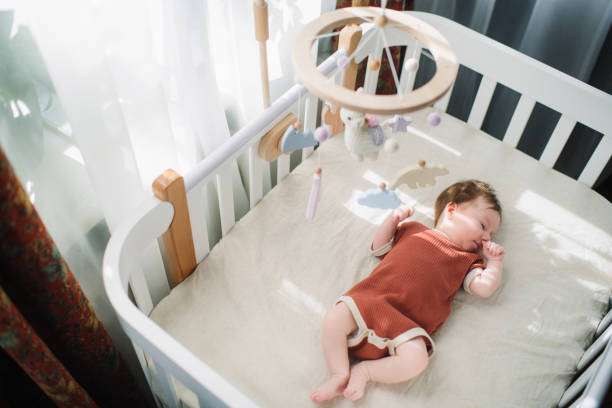
Posture is key to a baby’s comfortable sleep in the cradle. Correct posture not only keeps the baby stable but also protects the development of their spine and neck.
Back naturally curved
A newborn’s spine is C-shaped, unlike an adult’s. If the surface inside the cradle is too hard or too flat, the baby’s spine will be straightened, which can cause discomfort.
Tip: Use a thin, soft, supportive mat to allow the back to maintain its natural curve while ensuring breathability.
Neck support in place
Newborns have relatively large heads, and without support, their heads can easily tilt or slip.
Tip: Place a baby-specific pillow or soft cushion in the cradle to keep the neck in a neutral position.
Relax your hands and feet naturally
Many parents like to wrap their babies up very tightly, believing it to be safer. However, overly tight wrapping can stiffen the baby’s limbs and make them irritable.
Tip: Allow the baby’s limbs some freedom of movement, ensuring their safety.
My baby initially didn’t like sleeping in the baby bassinet and cried almost every day. At first, I put the bassinet in the living room, but the mattress was too firm and the swaddle was too tight, so the baby tossed and turned all night.
Later I tried adjusting a few details:
- Replace the cradle mat with a soft, breathable one to maintain the natural curve of the back;
- Use a small pillow to support your neck and gently rest your head on one side;
- The wrapping should be a little loose, allowing your hands and feet to move naturally.
- Rock the cradle gently at a slow pace, accompanied by soft white noise.
After the adjustment, the baby gradually adapted and was able to sleep for several hours in the cradle every day, which relieved me and gave me more confidence to take care of the baby.
Different babies may adapt in different ways.
Babies have different personalities and constitutions, so the time it takes for them to adapt to a baby bassinet will vary.
- Babies with a quieter temperament: They usually adapt within a few days and can fall asleep with gentle rocking.
- Babies who are easily irritable or have colic may need a week or even longer to adjust. Parents need to be patient and gradually adjust their posture and environment.
Parents should observe and adjust accordingly and not give up on the cradle just because of one crying fit.
Here are a few tips to help your baby better adapt to baby bassinet
- Warm and comfortable: Keep the cradle at a moderate temperature, neither too cold nor too hot.
- Gentle rocking: Adjust the amplitude and frequency of the rocking based on the baby’s feedback.
- White noise assistance: Gentle music or white noise can make babies feel more at ease.
- Establish a consistent bedtime routine: Maintain similar actions every night before bedtime, such as patting, soothing, or singing a lullaby, to help your baby feel secure.
- Gradual adaptation: If the baby cries, you can put him in the cradle for a short time at first and gradually increase the time.
FAQ:
Q1: Does a baby crying mean the cradle is unsafe?
Not necessarily. Crying is more often a sign of discomfort with the position or environment. Safety issues generally depend on whether the cradle’s design meets standards and is sturdy.
Q2: How long can a baby bassinet be used for?
It can generally be used until the baby can roll over, learn to crawl, or is overweight. Different brands have specific instructions, which parents can refer to.
Q3: What should I do if my baby doesn’t like sleeping in a cradle?
First, ensure the posture, temperature, and rocking method are suitable, then gradually increase the usage time. You can also let your baby sleep next to the cradle first and then slowly transition to using it.
Conclusion:
The baby bassinet lies not only in its small and cute size but also in providing babies with a comfortable, safe, and parent-friendly sleep environment.
If your baby doesn’t like sleeping in a cradle, don’t be impatient. Start by adjusting the position, the rocking motion, and the environment, gradually finding a method that suits your baby. Every baby is unique, and patience and care are key to making the cradle work.


