
In a growing number of families, dogs have become companions, while “baby bassinet” “” represents the beginning of new life. When both are in the same home, the most common concern for owners is how to maintain a safe distance between the dog and the baby bassinet.
Actually, getting dogs and babies to get along harmoniously isn’t difficult. The key lies in advance planning, environmental setup, behavioral training, and family routines. This article will explain in detail how to establish a safe distance so that babies can sleep peacefully in their baby bassinet, and dogs feel respected and secure.
Why do dogs need to keep a safe distance from baby bassinets?
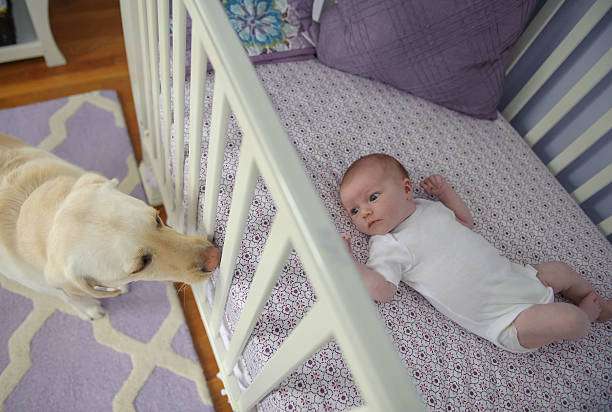
Even a very docile dog might accidentally approach a baby bassinet out of curiosity, nervousness, protectiveness, or excitement, or even climb onto the edge of the bassinet. Bassinet dogs are relatively light and agile, and if a dog pushes it with its paws, jumps on it, or even just nudges it with its nose, it could trigger:
The bassinet is tilted or shaken too much.
Frightening the baby
Accidentally scratching the bassinet fabric or mosquito net
The dog mistook the bassinet for a “new toy” or an object that needed protection.
Therefore, no matter how well-behaved or obedient your dog is, you must maintain a clear, stable, and sustainable safe distance between it and your baby bassinet through training and environmental management.
Get the dog used to the bassinet
Before the baby comes home, you can let the dog touch the bassinet first, which can greatly reduce its future anxiety or excessive curiosity.
1. Place the baby bassinet in advance.
Place the baby bassinet in its usual, consistent location and avoid frequent relocation. A dog’s territorial instincts stem from stability; the more fixed the bassinet’s location, the easier it is for the dog to remember, “This is an area not to be approached.”
2. Let the dog smell the bassinet.
Curiosity is a dog’s nature; let it smell the bassinet, don’t forbid it. But—
It can only “smell,” not “touch.”
You can gently tell it, “You can look, but don’t get too close.” Some dogs will observe for a few seconds and then walk away, which is the calm response you’re hoping for.
3. Do not treat the bassinet as a “forbidden item.”
If you become overly anxious and constantly try to push the dog away, it will only want to get closer to the baby bassinet. A natural, gentle approach is most effective.
Environmental setup: Using physical isolation to protect baby bassinet
This is the most direct and effective way.
1. Use baby safety gates
Place a simple fence around the bassinet so that the dog can see it but cannot touch it.
benefit:
Provide clear boundaries
It won’t make the dog feel “isolated.”
You feel more at ease when your baby is in the bassinet.
2. Place the bassinet in a higher position.
For example:
Beside the bed
Beside the sofa
In a fixed corner
Try to avoid placing the bassinet in a location where the dog can easily jump on or explore it.
3. Provide the dog with an “alternative area.”
If you want to keep your dog away from the baby bassinet, you must provide it with a comfortable alternative.
For example,
Place a comfortable dog bed at a safe distance from the bassinet.
Why is it effective?
Dogs feel more secure and emotionally stable when they have their place in the world.
baby bassinet due to boredom.
You can cultivate the habit of “going to bed to rest.”
Once, when I was taking care of my baby in the living room, my dog wanted to come over, but I gently said, “Sweetie, go to bed.” It glanced at the baby bassinet and then obediently went back to its own bed and lay down. This positive behavior is the result of early training and clear boundaries.
Behavioral training: Get the dog to voluntarily stay away from the bassinet
Training is key to truly maintaining a safe distance between dogs and baby bassinets.
1. Essential commands: No / Wait a minute / Go to bed
These commands can be practiced near the bassinet:
“No”: Prevent approaching
“Wait a minute”: To make the dog stay in place.
“Go to bed”: Guide the dog back to its designated area.
Training points:
When you first start practicing, don’t put the baby in the bassinet.
Reward the dog each time it backs up or understands a command.
Encouragement always outweighs punishment
2. Positive reinforcement training instead of yelling.
Howling at dogs will cause:
Dog nervous
The dog mistook the bassinet for a dangerous object.
Dogs can create negative associations with newborns
Therefore, it is essential to maintain a gentle, clear, and firm tone.
Daily family habits: Let the dog naturally maintain a safe distance
1. Taking care of the dog every day is exhausting.
Energetic dogs are more likely to run or jump around.
A dog that has just finished a walk or playing ball usually just wants to rest.
Moderate exercise = saving energy = being more disciplined.
2. Timing of feeding and receiving attention
Don’t let your dog feel neglected because of the baby bassinet or the addition of a baby to the family.
suggestion:
Your baby is sleeping in the baby bassinet; you can gently pet the dog.
Family members should take turns caring for the baby and the dog, with one person looking after the baby and another taking care of the dog.
Maintain your dog’s regular routine; do not suddenly change its food, outings, or time spent with you.
Dogs with stable emotions are more likely to follow your “bassinet distance rules.”
use of Baby Bassinet: Dog reaction management
Your baby first lies in the baby bassinet; you need to prepare your aura beforehand.
1. Remain calm when a dog approaches.
Don’t panic, and don’t rush to push the dog away.
The more nervous you are, the more the dog will sense something “unusual” happening.
2. Reward the dog promptly when it behaves calmly.
For example:
Sit quietly
Observe quietly
No jumping, no clinging to the bassinet
Reward it, let it know, “This behavior is right.”
3. Do not let the dog put its head in the bassinet.
Even wanting to smell the baby is not allowed.
This must be a “zero-tolerance” rule.
Visual occlusion: Reduces the chances of the dog being stimulated by the baby’s movements.
Sometimes dogs approach a bassinet not out of bad intentions, but because they are attracted by the baby’s hand and foot movements.
You can use:
A semi-transparent, lightweight curtain
Gentle mask
Adjust the direction of the baby bassinet
The premise is
It does not affect the ventilation of the bassinet
It won’t affect your ability to observe your baby.
This reduces the chances of the dog becoming overly excited.
Never leave a dog alone with its bassinet.
This is the bottom line of safety that all pediatric experts and pet behaviorists emphasize.
No matter how well-behaved or stable your dog is:
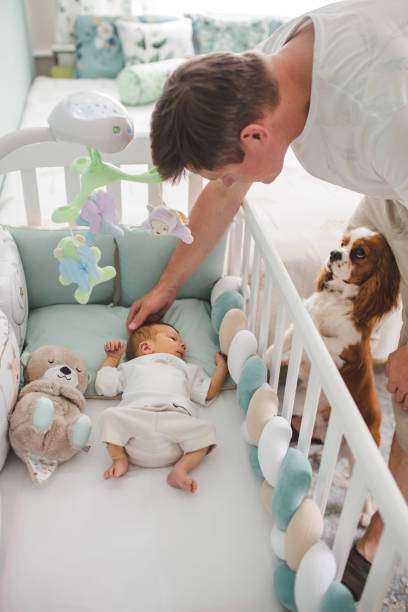
Dogs and babies in baby bassinets should not be left alone together.
When you leave the room, please take the dog with you or use physical barriers.
This is the only way to ensure zero risk.
Conclusion:
As long as you do:
Beforehand, familiarize the dog with the baby bassinet, establish clear physical boundaries, use positive training commands, provide emotional value and a stable daily routine, and always maintain necessary supervision.
You can let your baby sleep safely in a baby bassinet and also let your dog feel secure and integrated into the family.
If you are preparing to buy a suitable baby bassinet, you can also give priority to styles with higher stability, safer materials, and structures such as guardrails so that it is easier to establish a “safe zone” for your baby.


